Italian-born Michelangelo di Lodovico Buonarroti Simoni (1475–1564) was a tormented, prodigiously talented, and God-fearing Renaissance man. His manifold achievements in painting, sculpture, architecture, poetry, and engineering combined body, spirit, and God into visionary masterpieces that changed art history forever. Famed biographer Giorgio Vasari considered him the pinnacle of Renaissance achievement. His peers called him simply “Il Divino” (“the divine one”).This book p...
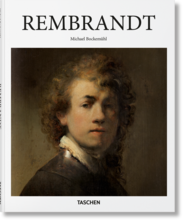
Rembrandt van Rijn (1606–1669) never left his homeland of the Netherlands but in his massive body of painting, drawing, and etching, he changed the course of Western art. His prolific oeuvre encompasses religious, historical, and secular scenes, as well as one of the most extraordinary series of portraits and self-portraits in history. Rembrandt’s work foregrounds texture, light, and acute observation.Like sudden, startling apparitions in a shadowy street, his subjects are il...
The work of Henri Matisse (1869–1954) reflects an ongoing belief in the power of brilliant colors and simple forms. Though famed in particular for his paintings, Matisse also worked with drawing, sculpture, lithography, stained glass, and collage, developing his unique cut-out medium when old age left him unable to stand and paint.Matisse’s subjects were often conventional: nudes, portraits, and figures in landscapes, Oriental scenes, and interior views, but in his handling o...
Georgia O’Keeffe (1887–1986) was a major figure in modern American art for some seven decades. Importantly, her fame was not associated with shifting art styles and trends, but rather with her own unique vision, based on finding essential and abstract forms in nature.O’Keeffe’s primary subjects were landscapes, flowers, and bones, each explored in successive series over several years. Certain works went on for decades, producing 12 or more variations of an original image. Amo...
In the latter half of the 19th century, in the verdant countryside near Aix-en-Provence, Paul Cézanne (1839–1906), busily plied his brush to landscapes and still lifes that would become anchors of modern art. With compact, intense dabs of paint and bold new approaches to light and space, he mediated the way from Impressionism to the defining movements of the early 20th century and became, in the words of both Matisse and Picasso, “father of us all.”This fresh artist introduct...
In art history, we tend to be on first name terms only with the most revered of masters. The Renaissance painter and architect Raphael Santi (1483–1520) is one such star. The man we call simply Raphael has for centuries been hailed as a supreme Renaissance artist. For some, he even outstrips his equally famous, equally first-named, contemporaries, Leonardo and Michelangelo.From 1500 to 1508, Raphael worked throughout central Italy, particularly in Florence where he secured hi...